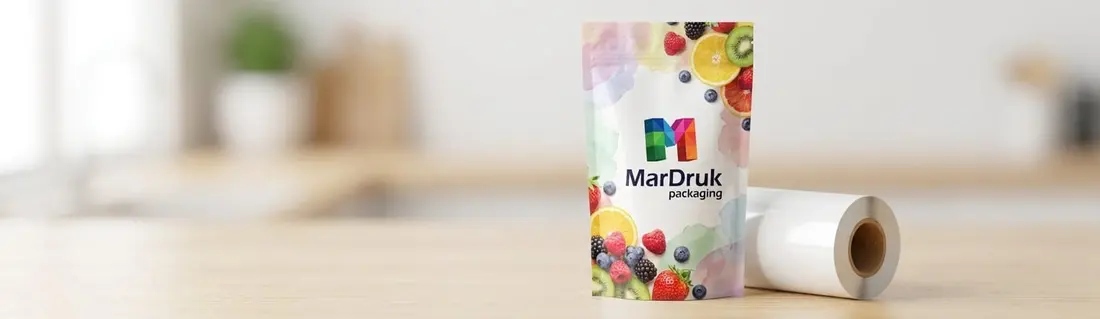
White BOPP film — when it works best
You choose the white variant when:
• strong brand identity and legibility are the priority.
• you want to hide the product or structural elements (e.g. seals, windows),
• you need a uniform background for small typography and codes,
• you care about a consistent appearance across batches and production sites.
The most common applications: confectionery and snacks, loose products (rice, groats, cereals, muesli), coffee/tea (as the outer layer), dairy/frozen food (high-strength laminates) and non-food (accessories, household chemicals).
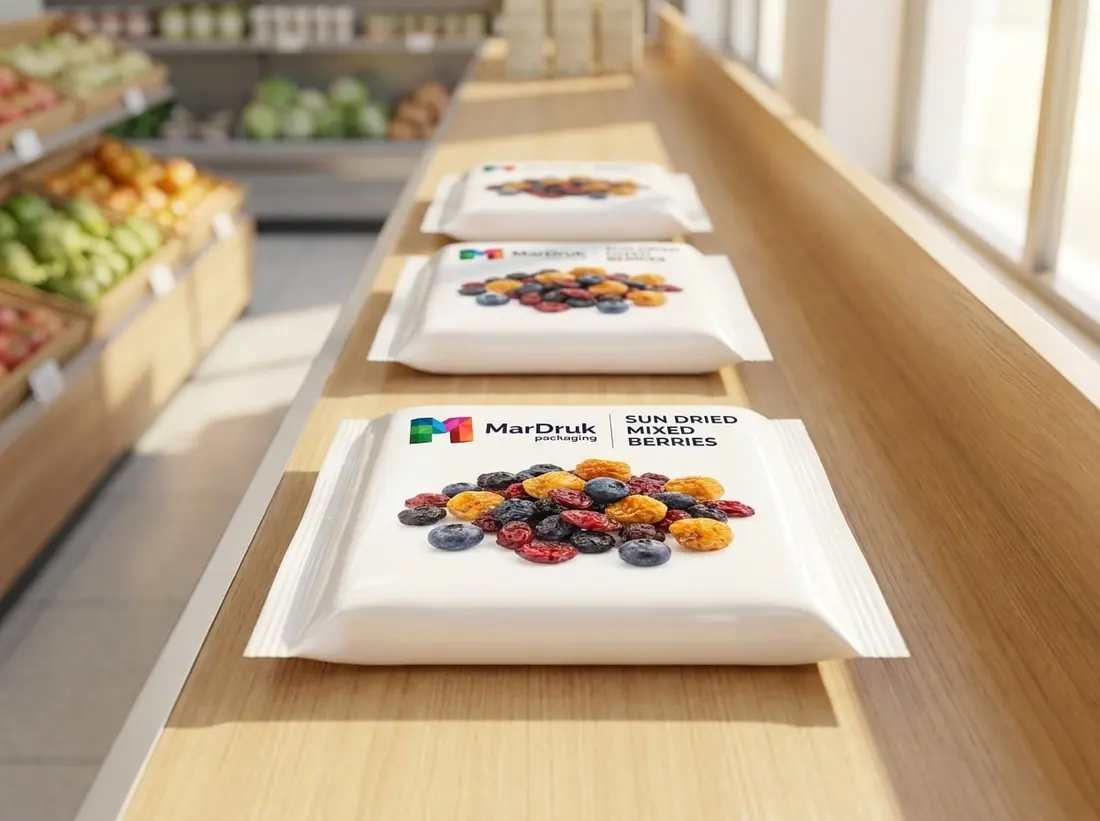
White BOPP film and print quality
The white base is the 'ideal canvas' for artwork. It provides:
• high opacity — less dependence on the backing white,
• full colour saturation and sharp detail edges,
• excellent legibility of small fonts and codes.
We print in multi-colour flexography with register control and conformance to the proof (proof = reel). On request we combine matt/gloss (varnish or lamination) and a metallised look through the appropriate laminate structure.
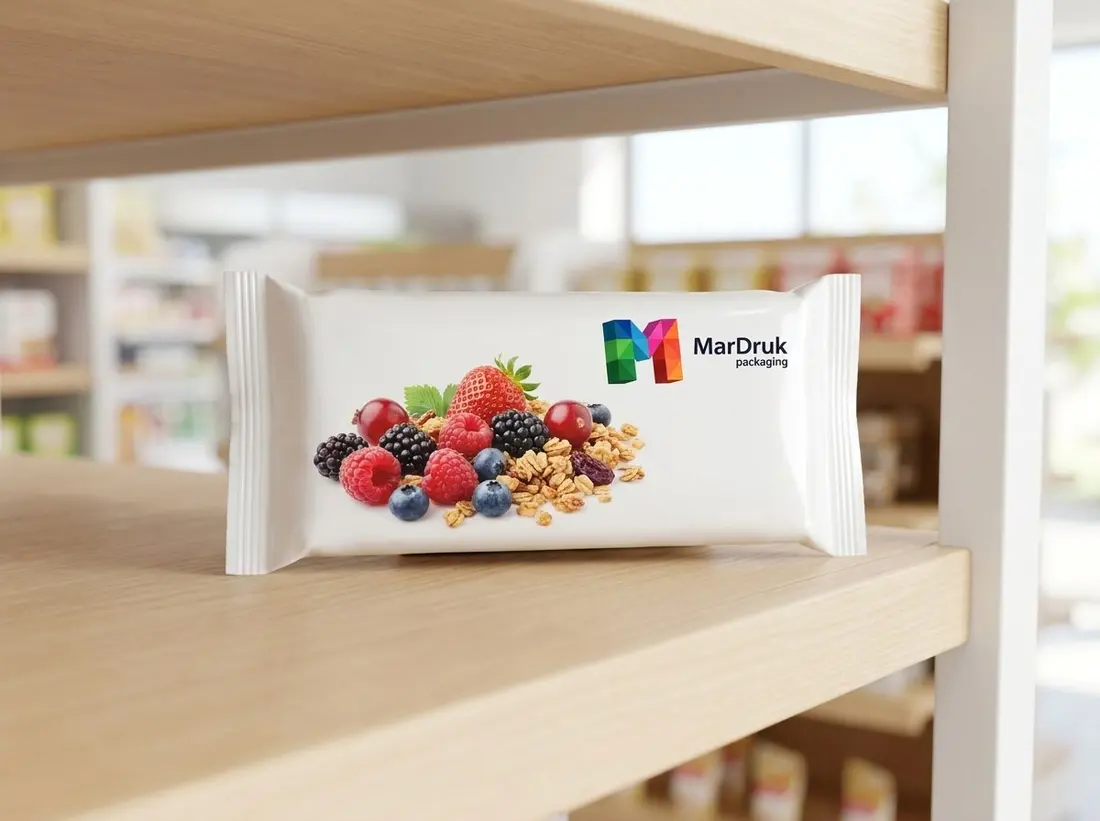
Running on the line — web stability, seal and friction
White BOPP film has good stiffness and resistance to creasing, therefore:
• it forms predictably over the tube,
• it holds even 'shoulders' and straight edges,
• it seals stably once the temperature and pressure are set.
The key is the coefficient of friction (COF) matched to speed and guidance. We also select the seal force/temperature so that start-up is short and the run is even, without micro-stops.
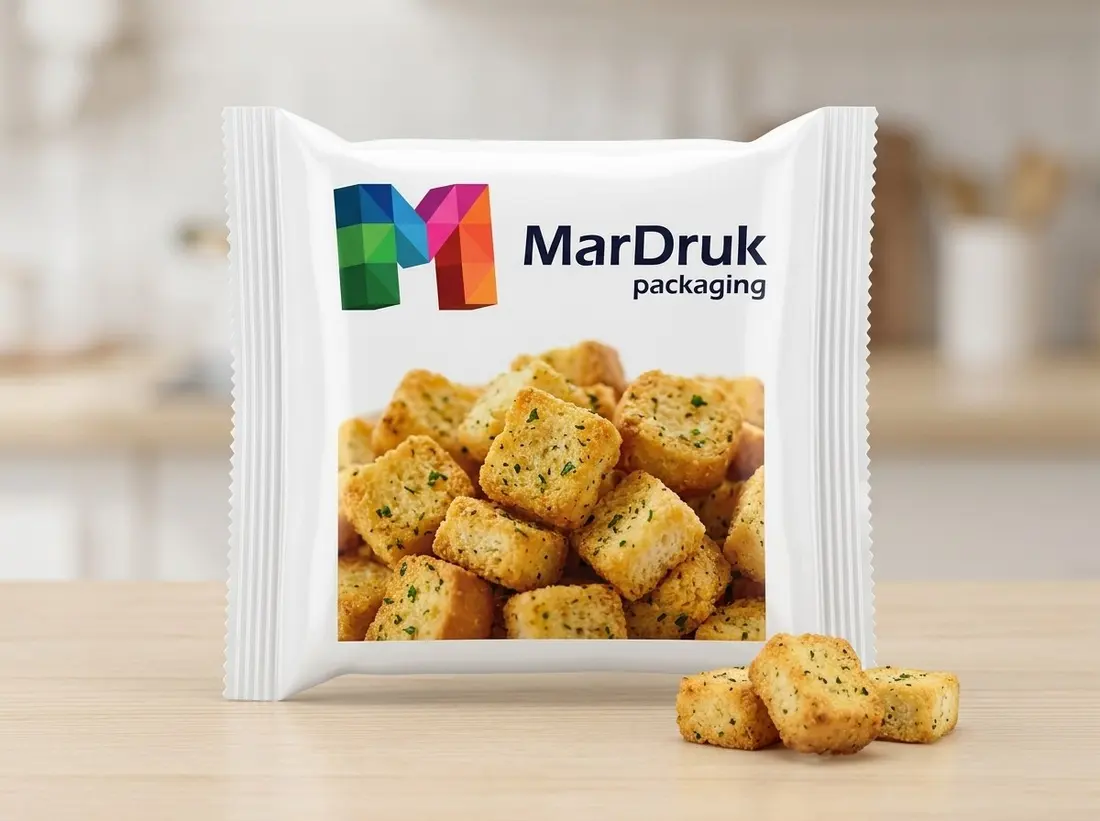
Designing artwork on white — practical tips
• Contrast: use the white background to strengthen brand colours and typography negatives.
• Technical zones: plan no-print under the seal, easy-open/laser-score notches and the date — you will save on adjustments.
• Windows: blend white with transparent through subtle frames and soft transitions, to avoid 'hard' edges.
• Matt/gloss: on white it gives a premium effect without losing the legibility of the information.
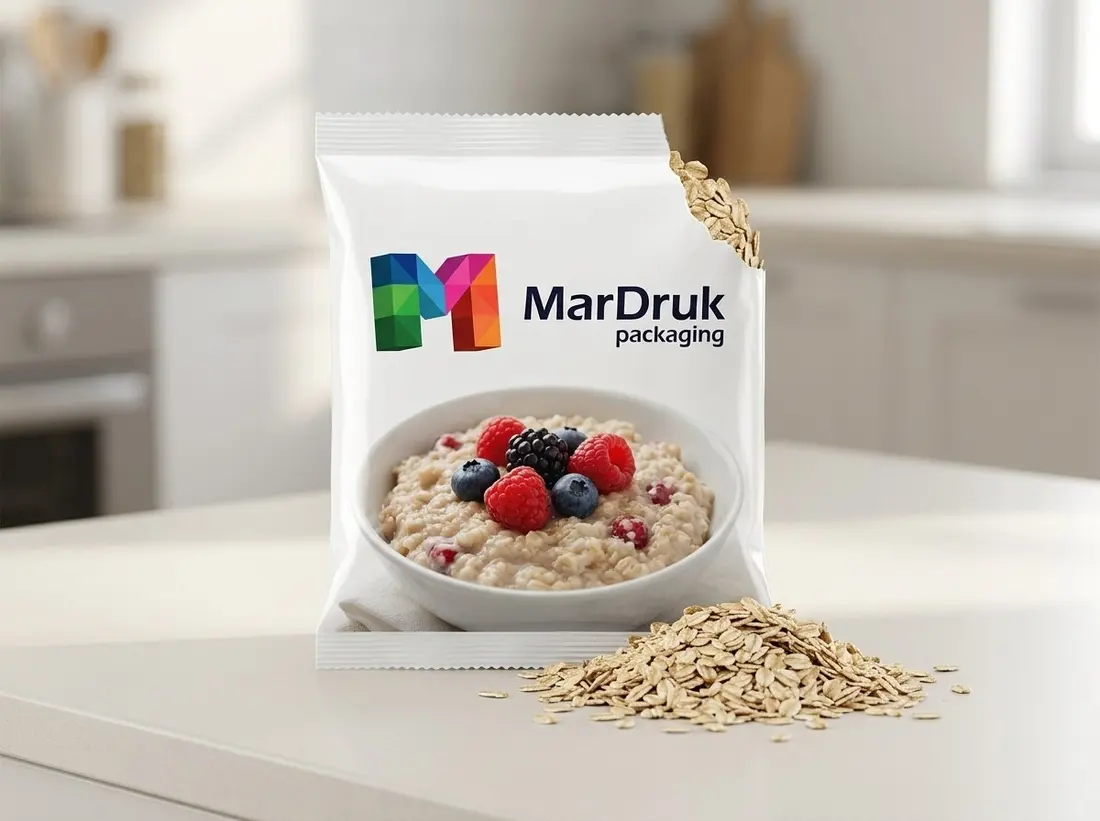
Summary — White BOPP film
If you want packaging that strongly builds the brand and at the same time runs evenly on the line, choose White BOPP film matched to the product and process. We will design the structure (including mono PP/PP), select the barrier, friction and seal, and combine the HD multi-colour print quality with the pack's functionality.
Take the next step:
• Order a free consultation and specification (structure, matt/gloss, windows, anti-fog).
• Order samples and a pilot run to confirm the parameters on your machine.
• Get a fast quote with a deadline that keeps to the calendar.
Write or call — we will reply quickly and to the point.
Frequently asked questions
Printed white BOPP film is a biaxially oriented polypropylene film with an opaque, white structure, intended for further printing and processing. It is distinguished by good dimensional stability, suitable stiffness and a surface that allows high-quality reproduction of artwork.
Printed white BOPP film is used above all as the outer layer in packaging structures, where it acts as the carrier of the artwork and the visual effect of the finished pack. Depending on the project it can be used in laminates with materials such as CPP, PE or barrier films.
When selecting the film you should take into account its thickness, the level of whiteness and opacity, the surface tension, the mechanical properties and compatibility with the printing technology and further processing. Requirements for lamination, abrasion resistance and the behaviour of the material on the packaging line are also important.
Yes, printed white BOPP film can be used successfully in flexographic printing, provided the surface is properly prepared and the process parameters are correctly chosen. Suitable surface tension, the choice of inks and control of the drying and rewinding conditions are of key importance.
In technological practice you should take into account the surface's abrasion resistance, the possibility of adhesion parameters changing over time and matching the material to the specific lamination and packaging process. Control of the processing parameters also matters, in order to keep the process stable and the quality of the final pack.
Sounds like your project?
Write or call — our technologist will advise on the structure and quote your volume within 24 hours.
Free quote +48 731 819 963 office@mardrukopakowania.pl